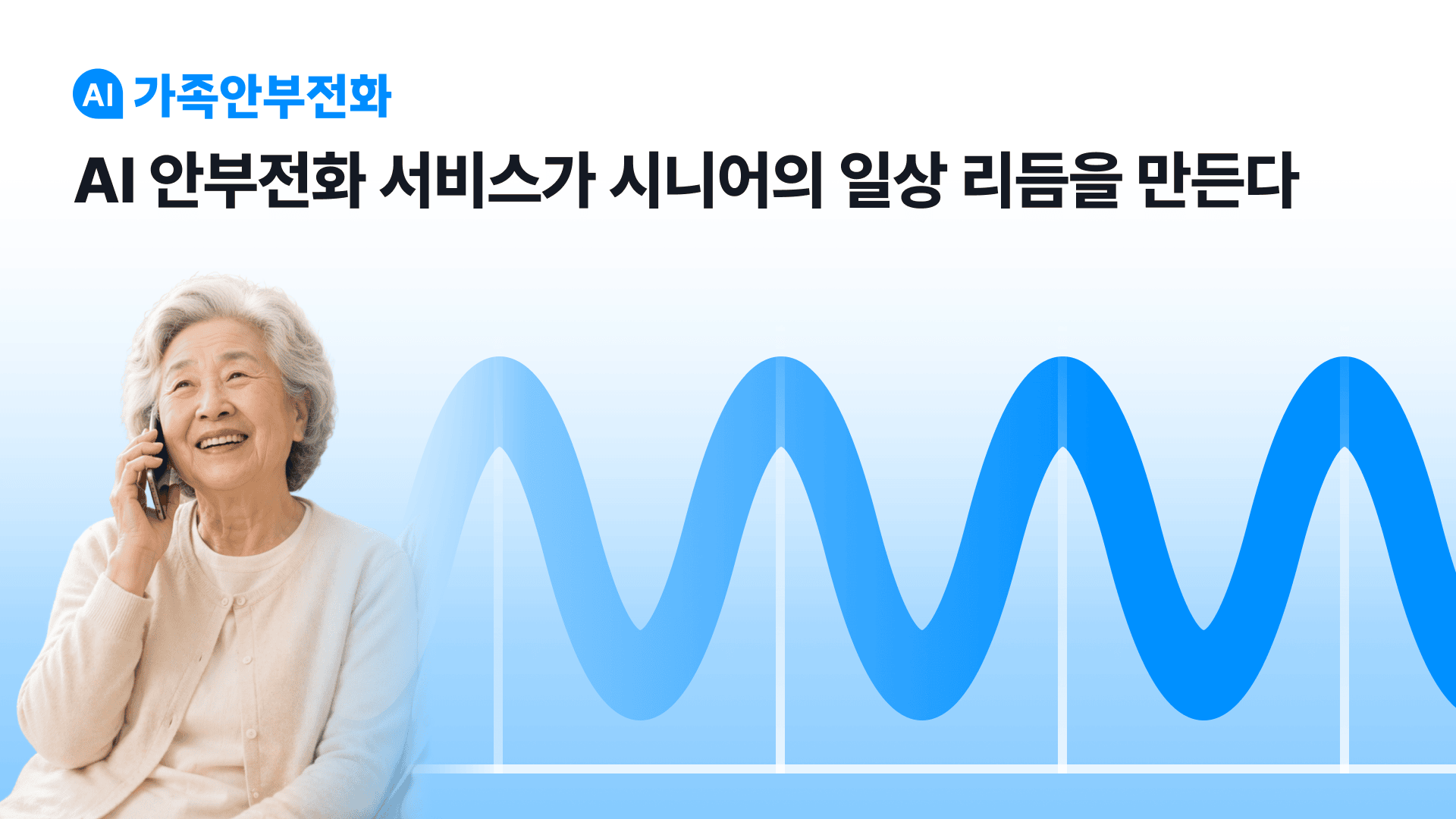
Amidst rapid 고령화, AI 안부전화 is gaining attention as a new care alternative, but objective data on its actual effectiveness has been lacking. In this situation, WESEEKS conducted 학술 based on real operational data from its AI 안부전화 ‘AI Family Safety Call’ service, scientifically proving the service’s effectiveness by demonstrating the potential for seniors’ 생활 rhythm 형성 and abnormal signs 감지.
The Era of 고령화, the Necessity of AI 안부전화 and Market 고령화
As the aging population rapidly progresses, the 안전 and care of seniors living alone have emerged as important challenges for our society. Traditional visiting care faces limitations in terms of personnel and costs, and emergency call devices have the constraint that seniors must recognize risks themselves. In this reality, AI 안부전화 enables efficient care by allowing seniors to simply receive a call without separate device installation, while the AI checks their meal, medication, and mood status and delivers reports to their families.
Thanks to these advantages, AI 안부전화 is actively operated as a 독거노인 project in various local governments, including Seoul and Busan, and private companies, including WESEEKS, are successively launching related services, forming the market. According to statistics related to 고령화 published by Statistics Korea in 2025, the domestic population aged 65 or older has exceeded 20% of the total, and WESEEKS estimates that the domestic AI care service market size as of 2025 grew by 38% compared to the previous year, showing its growth trend.
Beyond Subjective Satisfaction, Service Effectiveness Proven by Data
Until now, research on the effectiveness of AI 안부전화 has primarily focused on users’ subjective satisfaction or qualitative results, such as ‘reduction in loneliness’ or ’emotional 안정감’. While these were important achievements, objective evidence regarding the specific changes the service brings to seniors’ actual 행동 levels was insufficient. As the market grows, a clear answer to the question ‘Is AI Safety Call truly effective?’ has been demanded.
To address this gap, WESEEKS partnered with research teams led by Professor Hwang Sung-joo of Ewha Womans University and Professor Choi Min-ji of Inha University, providing actual operational data from its ‘AI Family Safety Call’ service for 학술. The research team focused on statistically verifying changes in seniors’ 행동 by analyzing a total of 7,613 call logs used by 547 seniors collected over 82 days from October to December 2025. This is significant as it marks the first attempt to scientifically prove the service’s effectiveness based on real data, going beyond previous qualitative studies.
AI-Created Daily Rhythms, New Possibilities for Abnormal Signs 감지
The key finding of this study is that the standard deviation of 응답 times significantly decreased in the group that used ‘AI Family Safety Call’ long-term (Mann-Whitney p=0.002). This means that unlike short-term user groups where 응답 times were dispersed across various times of the day after service subscription, long-term user groups showed a clear convergence of responses to specific times. In other words, the data demonstrated that the AI Safety Call contributes to forming a regular pattern in seniors’ daily lives, specifically a 생활 rhythm, where ‘the phone rings at this time’.
Through these results, the research team revealed that AI Safety Call goes beyond simply increasing call frequency; it functions by integrating the time seniors receive calls into their 생활 rhythm. More importantly, if such a stable 응답 pattern is formed, the moment that pattern is broken can be interpreted as an abnormal signal, suggesting the possibility of preventive 안전 management. For instance, if a senior who usually receives calls regularly at 9 AM repeatedly does not respond, this could be a significant indicator of a disturbance in their 생활 rhythm or a 건강, rather than just an absence.
This study suggests the possibility of developing an abnormal 감지 model based on 응답 patterns through the creation of individual 응답 time profiles. This means that by detecting changes like ‘reacting differently than usual at a specific time’ rather than the superficial fact of ‘not answering the phone today,’ a basis for more precise and timely care intervention can be established, and it is expected to be a significant turning point in the 고도화 of AI-based care services.
Promoting Service 고도화 with 생활 Pattern-Based care
Kim Ji-woo, CEO of WESEEKS, emphasized the significance of this 학술 by stating, “This is the first attempt to verify through data how our service actually impacts the daily lives of seniors.” He further announced his intention to ‘develop the service away from an evaluation method centered on connection rates and towards a 생활 pattern-based care 고도화 direction,’ expressing a commitment to providing innovative, data-driven care services.
This study was published in ‘Advanced Industrial SCIence’ Vol. 5, No. 2 (pp.52-59), 2026, an academic journal issued by the Korea Society of Small and Medium Business Convergence, and its academic value was recognized. Professor Hwang Sung-joo of Ewha Womans University, WESEEKS CEO Kim Ji-woo, and Professor Choi Min-ji of Inha University participated as co-authors in this research, leaving an exemplary case of verifying the effectiveness of an actual service through industry-academia collaboration. Based on these research findings, WESEEKS plans to implement more precise and personalized AI care services and lead the care paradigm in a 고령화 society.
WESEEKS’ research findings have proven that AI Safety Call goes beyond simple phone calls to provide seniors with stable routines and, furthermore, contribute to the early 감지 of potential risks. This is a clear example demonstrating the qualitative improvement and expansion potential of care services that AI technology can offer in a 고령화 society.
Moving forward, AI 안부전화 is expected to play a key role in supporting seniors’ healthy and stable later-life 생활 by building sophisticated data-driven care models.