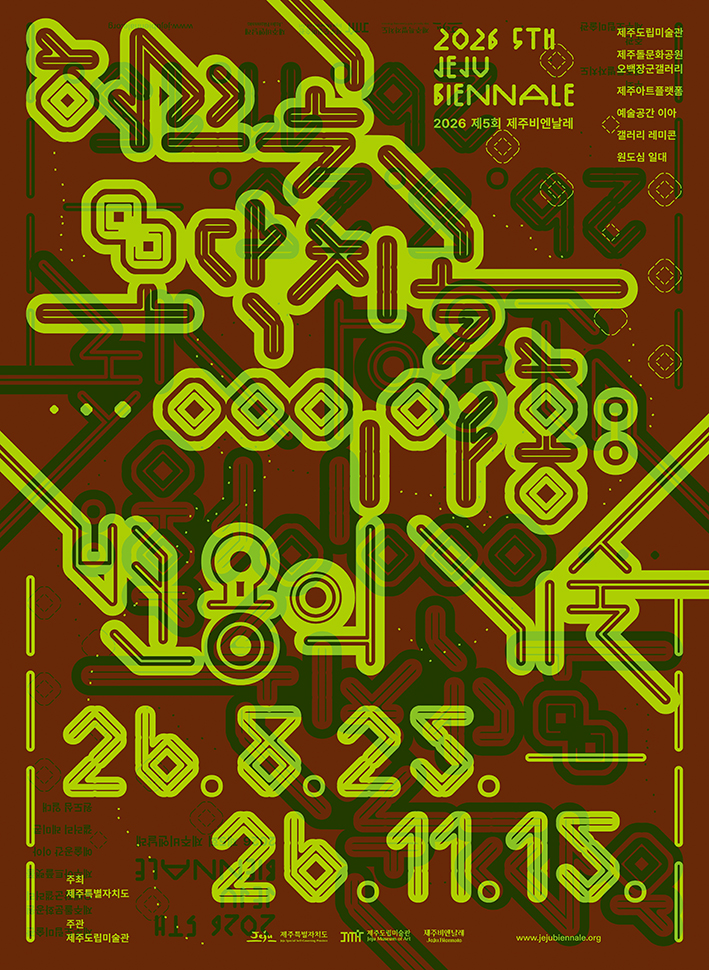
The Jeju Museum of Art (Director Lee Jong-hoo) has unveiled the participating artists, exhibition structure, and official poster (key visual) for the ‘2026 5th Jeju Biennale,’ opening on August 25.
This biennale is hosted by Jeju Special Self-Governing Province and organized by the Jeju Museum of Art, running for 83 days from August 25 to November 15.
The exhibition will take place in major cultural and artistic venues, including the Jeju Museum of Art, Jeju Stone Park, Jeju Art Platform in Jeju’s old downtown, Space Ia, and Gallery REMICON.
A total of 69 artists (teams) from Korea and abroad are participating, with Jeju artists accounting for approximately 30%. Based on Jeju’s regionality and sense of place, the biennale will present numerous new works and projects that resonate with and unite on world-historical and international issues, planning to revitalize the old downtown through diverse audience-participation exhibitions and programs.
The newly unveiled official poster (key visual) visualizes the process of different elements mixing (Heokkkeu-gok) and gathering (Modakchi-gok) to transform into new forms, by reconstituting Jeju language characters into geometric patterns.
This captures Jeju’s ever-expanding and non-fixed cultural and environmental characteristics, succinctly expressing the biennale’s theme.
The exhibition spatially embodies the process of mixing, gathering, and transforming, as signified by its theme, ‘Heokkkeu-gok Modakchi-gok Iyahong: The Art of Transformation.’
* Heokkkeu-gok Modakchi-gok: In Jeju language, ‘mixing and gathering’
** Iyahong: The chorus of the Jeju folk song ‘Iyahong Taryeong’
Furthermore, the expanded exhibition spaces, extending beyond the Jeju Museum of Art to Jeju Stone Park and the old downtown, weave disparate locations into a single narrative flow.
Focusing on the old downtown, where different times and cultures have accumulated from the Tamna Kingdom era to the present, the exhibition re-examines the meaning of historical communal identity. It is structured to allow visitors to directly experience the ‘Aesthetics of Survival’ and the ‘Flow of Transformation,’ showcasing the process of various elements encompassing art culture and material civilization mixing and combining.
The exhibition is divided into three sub-themes.
‘From Chusa’s Perspective: Exile Human,’ presented at the Jeju Museum of Art, reinterprets Chusa Kim Jeong-hui in terms of Jeju’s formative characteristics and highlights the lineage of Jeju’s form and aesthetics shaped under the condition of exile.
Chusa Kim Jeong-hui completed ‘Chusa-che’ and established his unique formative language even amidst unfamiliar environments and isolation. This connects with the aesthetics of ‘Jol’ (clumsiness/naivete) seen in Jeju’s folk paintings (munjado), folk art (minhwa), and stone carvings (seokmul), demonstrating that exile functioned not as a severance but as a condition for the creation of new senses and forms.
This section focuses on Jeju’s unique local characteristics (poongtoseong) that regain originality even under the condition of exile, exploring the flow of Jeju aesthetics from the expression of Jeju embodied in Kim Young-hoon’s dolmen (dongjaseok) to the complex system aesthetics of Lee Hyun-tae’s works.
Furthermore, through the works of artists such as Aslan Gaisumov, Alaa Edrees, and Yoon Jin-mee, it sheds light on the enduring memories of individuals and communities amidst war, historical violence, and rapid life transitions, reinterpreting stories related to exile (political exile and historical violence) from a contemporary perspective and expanding them into international themes.
‘Dark Stone Rolls and Rolls: Stone Culture Stone,’ held at Jeju Stone Park, views Jeju’s basalt as a witness to time and history, exploring the flow from Northern megalithic culture to contemporary aesthetics.
In volcanic Jeju, stone has served as both an object to overcome and a foundation for life, forming a unique stone wall culture with forms like jipdam (house walls), batdam (field walls), and sandam (mountain walls). Kim Jeong-heon and Masao Okabe + Chihiro Minato present works that connect places, while Noh Jin-ah and Roomtone propose a multi-dimensional aesthetic that crosses digital platforms and virtual worlds.
In Jeju’s old downtown, ‘Great Grandmother’s Navel: Myths Deities’ unfolds across Jeju Art Platform, Space Ia, and Gallery REMICON. This section aesthetically reinterprets the multi-layered nature and inclusivity of Jeju myths, which have integrated with Northern myths and encompass everything from nature worship to daily life.
Jeju’s myths, the ‘home of eighteen thousand gods,’ have been shaped through contact with external civilizations. Like the narrative of the goddess ‘Baekjutto’ who emerged from Namsan in Seoul and crossed over to Jeju, or Seolmundae Halmang who resonates with volcano goddess myths from around the world, Jeju myths have always interacted, blended, and expanded.
This section highlights the inclusivity and multi-layered life energy embedded in this polytheistic culture, with participation from artists such as Kim Sang-don, Son Yu-jin, Kwak Yun-ju, Ahn Jung-ju, Vincent Morisset, Zhanna Kadyrova, Kim Hee-eun, Koo Gi-jung, and Yang Jung-wook.
Launched in 2017, the Jeju Biennale, based on 10 years of accumulated experience, proposes directions for Jeju and the biennale to move forward together to the next stage.
Lee Jong-hoo, Director of the Jeju Museum of Art and Artistic Director of the Jeju Biennale, stated, ‘This biennale, arriving at a moment of transition, holds a more special and significant meaning than ever before.’ He added, ‘We hope it becomes a venue for artistic and cultural play, where residents can see, participate in, and harmonize with art throughout the old downtown, imbued with their memories and reminiscences, echoing ‘Heokkkeu-gok, Modakchi-gok, Iyahong.”
The ‘2026 5th Jeju Biennale’ will deeply explore Jeju’s unique regionality and historicity, presenting artistic endeavors that connect with global issues. Like the biennale’s theme, ‘mixing, gathering, and transforming,’ we anticipate the Jeju Biennale will be a dynamic festival where art and life intertwine, attracting much interest and participation.